

Bugs Bunny Dressed Like A Woman
| Bugs Bunny | |
|---|---|
| Looney Tunes/Merrie Melodies character | |
 | |
| First appearance | Porky's Hare Hunt (preliminary version)[1] April 30, 1938 A Wild Hare (official)[1] July 27, 1940 |
| Created by | Preliminary Version Ben Hardaway Cal Dalton Charles Thorson Official Tex Avery Chuck Jones Bob Givens Robert McKimson |
| Designed by | Preliminary Version Cal Dalton Charles Thorson (1939–1940) Official Bob Givens (1940–1943) Robert McKimson (1943–) |
| Voiced by | Mel Blanc (1938–1989) Jeff Bergman (1990–1993, 1997–1998, 2002–2004, 2007, 2011–nowadays) Greg Burson (1990–2000) Baton West (1996–2006) Joe Alaskey (1997–2011) Sam Vincent (Baby Looney Tunes; 2001–2006) Eric Bauza (2018–nowadays) (see beneath) |
| In-universe data | |
| Species | Hare/Rabbit[2] [three] |
| Gender | Male |
| Spouse | Mrs. Bugs Bunny (ex-wife) |
| Meaning others | Lola Bunny (since Space Jam) Honey Bunny (ex-girlfriend in comics) |
| Relatives | Clyde Bunny (nephew) |
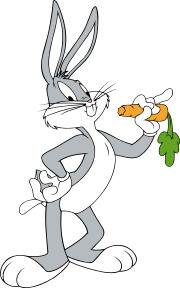
Bugs Bunny is an animated cartoon character created in the late 1930s by Leon Schlesinger Productions (afterward Warner Bros. Cartoons) and voiced originally by Mel Blanc.[four] Bugs is all-time known for his starring roles in the Looney Tunes and Merrie Melodies series of animated short films, produced by Warner Bros. Though an early image of the graphic symbol outset appeared in the WB drawing Porky's Hare Hunt (1938) and a few subsequent shorts, the definitive label of Bugs Bunny is widely credited to have debuted in director Tex Avery'south Oscar-nominated picture show A Wild Hare (1940).[i]
Bugs is an anthropomorphic gray and white rabbit or hare who is famous for his brassy, insouciant personality. He is also characterized by a Brooklyn accent, his portrayal equally a trickster, and his catch phrase "Eh...What's up, medico?". Due to Bugs' popularity during the golden age of American animation, he became non only an American cultural icon and the official mascot of Warner Bros. Entertainment, just also one of the most recognizable characters in the world. He tin thus be seen in the older Warner Bros. company logos.[five]
Bugs starred in more than than 160 cartoon shorts produced betwixt 1940 and 1964.[6] He has since appeared in feature films, compilation films, Goggle box series, music records, comics, video games, honor shows, entertainment park rides, and commercials. He has also appeared in more films than any other cartoon graphic symbol,[7] is the 9th most-portrayed picture personality in the globe,[7] and has his own star on the Hollywood Walk of Fame.[8]
Development [edit]

Bugs' preliminary debut (as an unnamed trivial white rabbit) in Porky's Hare Hunt (1938).
According to Chase Craig, who wrote and drew the first Bugs Bunny comic Sunday pages and the first Bugs comic book, "Bugs was non the creation of whatever one human; however, he rather represented the artistic talents of perhaps five or six directors and many cartoon writers including Charlie Thorson.[nine] In those days, the stories were oft the piece of work of a group who suggested various gags, bounced them around and finalized them in a joint story conference."[10] A prototype Bugs rabbit with some of the personality of a finalized Bugs, though looking very unlike, was originally featured in the film Porky'due south Hare Hunt, released on April 30, 1938. It was co-directed by Ben "Bugs" Hardaway and an uncredited director Cal Dalton (who was responsible for the initial design of the rabbit). This cartoon has an nearly identical plot to Avery's Porky'south Duck Hunt (1937), which had introduced Daffy Duck. Porky Hog is once more cast as a hunter tracking a lightheaded prey who is more interested in driving his pursuer insane and less interested in escaping. Hare Hunt replaces the petty blackness duck with a modest white rabbit. According to Friz Freleng, Hardaway and Dalton had decided to "dress the duck in a rabbit suit".[11] The white rabbit had an oval head and a shapeless body. In characterization, he was "a rural buffoon". Mel Blanc gave the character a vocalisation and express mirth much like those he later used for Woody Woodpecker. He was loud, zany with a goofy, guttural laugh.[12] The rabbit grapheme was popular enough with audiences that the Termite Terrace staff decided to apply information technology again.[13]
The rabbit comes back in Prest-O Modify-O (1939), directed by Chuck Jones, where he is the pet rabbit of unseen character Sham-Fu the Magician. Ii dogs, fleeing the local dogcatcher, enter his[ whose? ] absent chief'due south house. The rabbit harasses them merely is ultimately bested by the bigger of the 2 dogs. This version of the rabbit was cool, graceful, and controlled. He retained the guttural laugh but was otherwise silent.[12]
The rabbit'due south 3rd appearance comes in Hare-um Scare-um (1939), directed over again by Dalton and Hardaway. This cartoon—the first in which he is depicted as a gray bunny instead of a white ane—is also notable equally the rabbit's first singing role. Charlie Thorson, lead animator on the motion picture, gave the character a name. He had written "Bug's Bunny" on the model sheet that he drew for Hardaway.[13] [14] In promotional material for the drawing, including a surviving 1939 presskit, the name on the model sheet was altered to get the rabbit'south own proper name: "Bugs" Bunny (quotation marks only used, on and off, until 1944).[xv]
In his autobiography, Blanc claimed that some other proposed name for the character was "Happy Rabbit."[16] In the bodily cartoons and publicity, yet, the name "Happy" only seems to have been used in reference to Bugs Hardaway. In Hare-um Scare-um, a newspaper headline reads, "Happy Hardaway."[17] Animation historian David Gerstein disputes that "Happy Rabbit" was always used as an official name, arguing that the only usage of the term came from Mel Blanc himself in humorous and fanciful tales he told about the character'southward development in the 1970s and 1980s; the name "Bugs Bunny" was used as early as Baronial 1939, in the Motion picture Herald, in a review for the short Hare-um Scare-um.[xviii]
Thorson had been approached by Tedd Pierce, caput of the story department, and asked to pattern a better rabbit. The determination was influenced by Thorson's experience in designing hares. He had designed Max Hare in Toby Tortoise Returns (Disney, 1936). For Hardaway, Thorson created the model canvass previously mentioned, with six unlike rabbit poses. Thorson's model sheet is "a comic rendition of the stereotypical fuzzy bunny". He had a pear-shaped body with a protruding rear end. His face was flat and had big expressive eyes. He had an exaggerated long neck, gloved hands with three fingers, oversized feet, and a "smart aleck" grin. The end issue was influenced past Walt Disney Animation Studios' trend to draw animals in the style of cute infants.[xi] He had an obvious Disney influence, simply looked similar an awkward merger of the lean and streamlined Max Hare from The Tortoise and the Hare (1935) and the circular, soft bunnies from Little Hiawatha (1937).[12]
In Jones' Elmer's Candid Camera (1940), the rabbit first meets Elmer Fudd. This time the rabbit looks more like the nowadays-day Bugs, taller and with a similar face up—but retaining the more primitive voice. Candid Camera's Elmer graphic symbol design is also different: taller and chubbier in the face than the modern model, though Arthur Q. Bryan'south character voice is already established.
Official debut [edit]
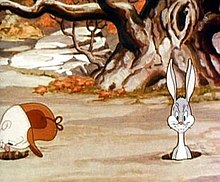
While Porky'due south Hare Hunt was the first Warner Bros. cartoon to feature a prototype of Bugs Bunny, A Wild Hare, directed past Tex Avery and released on July 27, 1940, is widely considered to exist the first official Bugs Bunny cartoon.[1] [19] It is the first film where both Elmer Fudd and Bugs, both redesigned by Bob Givens, are shown in their fully developed forms every bit hunter and tormentor, respectively; the first in which Mel Blanc uses what became Bugs' standard vocalization; and the first in which Bugs uses his catchphrase, "What's upwards, Physician?"[20] A Wild Hare was a huge success in theaters and received an Academy Honour nomination for Best Cartoon Short Subject.[21]
For the flick, Avery asked Givens to remodel the rabbit. The issue had a closer resemblance to Max Hare. He had a more elongated body, stood more cock, and looked more poised. If Thorson's rabbit looked like an baby, Givens' version looked like an adolescent.[11] Blanc gave Bugs the voice of a city slicker. The rabbit was as audacious as he had been in Hare-um Scare-um and equally absurd and collected as in Prest-O Change-O.[12]
Immediately post-obit on A Wild Hare, Bob Clampett's Patient Porky (1940) features a cameo advent past Bugs, announcing to the audition that 750 rabbits take been born. The gag uses Bugs' Wild Hare visual design, merely his goofier pre-Wild Hare phonation characterization.
The 2nd full-fledged role for the mature Bugs, Chuck Jones' Elmer's Pet Rabbit (1941), is the outset to use Bugs' name on-screen: it appears in a championship carte, "featuring Bugs Bunny," at the first of the motion-picture show (which was edited in following the success of A Wild Hare). However, Bugs' vocalism and personality in this cartoon is noticeably different, and his pattern was slightly altered equally well; Bugs' visual design is based on the prototype rabbit in Candid Camera, but with yellow gloves and no buck teeth, has a lower-pitched vocalisation and a more aggressive, arrogant and thuggish personality instead of a fun-loving personality. Later Pet Rabbit, however, subsequent Bugs appearances returned to normal: the Wild Hare visual design and personality returned, and Blanc re-used the Wild Hare vocalism label.
Hiawatha'southward Rabbit Chase (1941), directed past Friz Freleng, became the 2nd Bugs Bunny drawing to receive an University Award nomination.[22] The fact that it did not win the laurels was later spoofed somewhat in What's Cookin' Medico? (1944), in which Bugs demands a recount (claiming to be a victim of "sa-bo-TAH-gee") after losing the Oscar to James Cagney and presents a clip from Hiawatha'due south Rabbit Hunt to prove his point.[23]
World State of war II [edit]

Evolution of Bugs' pattern over the years.
By 1942, Bugs had become the number 1 star of Merrie Melodies. The serial was originally intended only for one-shot characters in films after several early attempts to innovate characters (Foxy, Goopy Geer, and Piggy) failed under Harman–Ising. Past the mid-1930s, nether Leon Schlesinger, Merrie Melodies started introducing newer characters. Bugs Bunny Gets the Boid (1942) shows a slight redesign of Bugs, with less-prominent front teeth and a rounder head. The character was reworked by Robert McKimson, then an animator in Clampett'due south unit. The redesign at first was only used in the films created by Clampett'due south unit, merely in time information technology was taken up by the other directors, with Freleng and Frank Tashlin the first. For Tortoise Wins by a Hare (1943), he created even so another version, with more slanted optics, longer teeth and a much larger rima oris. He used this version until 1949 (as did Fine art Davis for the one Bugs Bunny flick he directed, Bowery Bugs) when he started using the version he had designed for Clampett. Jones came up with his own slight modification, and the voice had slight variations betwixt the units.[fourteen] Bugs also made cameos in Avery's last Warner Bros. cartoon, Crazy Cruise.[24]
Since Bugs' debut in A Wild Hare, he appeared merely in color Merrie Melodies films (making him one of the few recurring characters created for that series in the Schlesinger era prior to the full conversion to colour), alongside Egghead, Inki, Sniffles, and Elmer Fudd (who really co-existed in 1937 forth with Egghead every bit a dissever character). While Bugs made a cameo in Porky Pig's Feat (1943), this was his only appearance in a blackness-and-white Looney Tunes movie. He did not star in a Looney Tunes film until that series made its complete conversion to simply color cartoons starting time in 1944. Buckaroo Bugs was Bugs' first motion-picture show in the Looney Tunes series and was also the last Warner Bros. drawing to credit Schlesinger (as he had retired and sold his studio to Warner Bros. that year).[23]
Bugs' popularity soared during Globe War 2 because of his free and piece of cake attitude, and he began receiving special star billing in his cartoons by 1943. By that fourth dimension, Warner Bros. had become the virtually profitable cartoon studio in the Usa.[25] In company with drawing studios such every bit Disney and Famous Studios, Warners pitted its characters against Adolf Hitler, Benito Mussolini, Francisco Franco, and the Japanese. Bugs Bunny Nips the Nips (1944) features Bugs at odds with a group of Japanese soldiers. This drawing has since been pulled from distribution due to its delineation of Japanese people.[26] One US Navy propaganda film saved from destruction features the phonation of Mel Blanc in "Tokyo Woes"[27] (1945) nigh the propaganda radio host Tokyo Rose. He also faces off against Hermann Göring and Hitler in Herr Meets Hare (1945), which introduced his well-known reference to Albuquerque as he mistakenly winds up in the Black Woods of 'Joimany' instead of Las Vegas, Nevada.[28] Bugs also appeared in the 1942 two-minute U.S. war bonds commercial flick Any Bonds Today?, along with Porky and Elmer.
At the end of Super-Rabbit (1943), Bugs appears wearing a Usa Marine Corps wearing apparel blue uniform. As a result, the Marine Corps made Bugs an honorary Marine master sergeant.[29] From 1943 to 1946, Bugs was the official mascot of Kingman Army Airfield, Kingman, Arizona, where thousands of aeriform gunners were trained during Globe War II. Some notable trainees included Clark Gable and Charles Bronson. Bugs too served as the mascot for 530 Squadron of the 380th Bombardment Group, fifth Air Force, U.S. Air Force, which was attached to the Royal Australian Air Forcefulness and operated out of Australia's Northern Territory from 1943 to 1945, flying B-24 Liberator bombers.[30] Bugs riding an air delivered torpedo served as the squadron logo for Marine Torpedo/Bomber Squadron 242 in the Second Earth War. Additionally, Bugs appeared on the nose of B-24J #42-110157, in both the 855th Flop Squadron of the 491st Bombardment Grouping (Heavy) and later in the 786th BS of the 466th BG(H), both being part of the eighth Air Force operating out of England.
In 1944, Bugs Bunny made a cameo appearance in Jasper Goes Hunting, a Puppetoons film produced past rival studio Paramount Pictures. In this cameo (blithe by McKimson, with Blanc providing the usual vocalisation), Bugs (afterwards existence threatened at gunpoint) pops out of a rabbit pigsty, saying his usual catchphrase; after hearing the orchestra play the incorrect theme song, he realizes "Hey, I'yard in the wrong film!" and then goes dorsum in the hole.[31] Bugs besides made a cameo in the Individual Snafu brusk Gas, in which he is institute stowed away in the titular private's belongings; his just spoken line is his usual catchphrase.
Although it was unremarkably Porky Pig who brought the Looney Tunes films to a close with his stuttering, "That'due south all, folks!", Bugs replaced him at the end of Hare Tonic and Baseball game Bugs, bursting through a pulsate just equally Porky did, but munching on a carrot and saying, in his Bronx/Brooklyn emphasis, "And that's the finish!"
Post-Globe War II era [edit]
Later on World War 2, Bugs connected to appear in numerous Warner Bros. cartoons, making his last "Golden Historic period" appearance in Faux Hare (1964). He starred in over 167 theatrical curt films, about of which were directed by Friz Freleng, Robert McKimson, and Chuck Jones. Freleng's Knighty Knight Bugs (1958), in which a medieval Bugs trades blows with Yosemite Sam and his fire-breathing dragon (which has a cold), won an Academy Award for Best Cartoon Short Discipline (becoming the start and only Bugs Bunny cartoon to win said laurels).[32] Three of Jones' films—Rabbit Fire, Rabbit Seasoning and Duck! Rabbit, Duck!—etch what is often referred to as the "Rabbit Flavor/Duck Flavour" trilogy and were the origins of the rivalry between Bugs and Daffy Duck.[33] Jones' classic What's Opera, Doc? (1957), casts Bugs and Elmer Fudd in a parody of Richard Wagner's Der Ring des Nibelungen. Information technology was deemed "culturally meaning" by the U.s.a. Library of Congress and selected for preservation in the National Film Registry in 1992, becoming the commencement cartoon brusk to receive this honor.[34]
In the fall of 1960, ABC debuted the prime number-time television program The Bugs Bunny Show. This show packaged many of the post-1948 Warners cartoons with newly animated wraparounds. Throughout its run, the serial was highly successful, and helped cement Warner Bros. Blitheness equally a mainstay of Sabbatum-morn cartoons. After two seasons, it was moved from its evening slot to reruns on Sabbatum mornings. The Bugs Bunny Show changed format and exact championship frequently but remained on network boob tube for 40 years. The packaging was subsequently completely different, with each drawing simply presented on its own, title and all, though some clips from the new bridging textile were sometimes used as filler.[35]
Later years [edit]
Bugs did not appear in any of the post-1964 Looney Tunes and Merrie Melodies films produced by DePatie-Freleng Enterprises or Seven Arts Productions, nor did he appear in Filmation's Daffy Duck and Porky Hog Meet the Groovie Goolies. He did, however, have 2 cameo appearances in the 1974 Joe Adamson short A Political Drawing; one at the get-go of the short, and another in which he is interviewed at a pet store. Bugs was animated in this short by Mark Kausler.[36] He did not appear in new material on-screen again until Bugs and Daffy'due south Funfair of the Animals aired in 1976.
From the late 1970s through the early 1990s, Bugs was featured in various blithe specials for network boob tube, such equally Bugs Bunny's Thanksgiving Nutrition, Bugs Bunny's Easter Special, Bugs Bunny's Looney Christmas Tales, and Bugs Bunny's Bustin' Out All Over. Bugs also starred in several theatrical compilation features during this time, including the United Artists distributed documentary Bugs Bunny: Superstar (1975)[37] [38] and Warner Bros.' own releases: The Bugs Bunny/Road Runner Motion picture (1979), The Looney Looney Looney Bugs Bunny Movie (1981), Bugs Bunny'due south third Moving picture: 1001 Rabbit Tales (1982), and Daffy Duck's Quackbusters (1988).
In the 1988 live-action/animated comedy Who Framed Roger Rabbit, Bugs appeared equally ane of the inhabitants of Toontown. Notwithstanding, since the film was being produced by Disney, Warner Bros. would merely let the apply of their biggest star if he got an equal amount of screen time as Disney's biggest star, Mickey Mouse. Because of this, both characters are always together in frame when onscreen. Roger Rabbit was as well one of the final productions in which Mel Blanc voiced Bugs (every bit well as the other Looney Tunes characters) before his death in 1989.
Bugs after appeared in another blithe production featuring numerous characters from rival studios: the 1990 drug prevention Tv special Drawing All-Stars to the Rescue.[39] [twoscore] [41] This special is notable for being the commencement time that someone other than Blanc voiced Bugs and Daffy (both characters were voiced by Jeff Bergman for this). Bugs also made guest appearances in the early on 1990s television series Tiny Toon Adventures, as the principal of Tiptop Looniversity and the mentor of Babs and Buster Bunny. He made further cameos in Warner Bros.' subsequent animated Television shows Taz-Mania, Animaniacs, and Histeria!
Bugs returned to the silverish screen in Box-Role Bunny (1991). This was the first Bugs Bunny cartoon since 1964 to be released in theaters and it was created for Bugs' 50th anniversary celebration. It was followed by (Blooper) Bunny, a drawing that was shelved from theaters,[42] but afterward premiered on Cartoon Network in 1997 and has since gained a cult following among blitheness fans for its edgy humor.[43] [44] [45]
In 1996, Bugs and the other Looney Tunes characters appeared in the live-activeness/animated film, Space Jam, directed by Joe Pytka and starring NBA superstar Michael Jordan. The movie also introduced the grapheme Lola Bunny, who becomes Bugs' new love involvement. Space Jam received mixed reviews from critics,[46] [47] but was a box office success (grossing over $230 million worldwide).[48] The success of Infinite Jam led to the evolution of another live-action/animated film, Looney Tunes: Back in Action, released in 2003 and directed by Joe Dante. Unlike Space Jam, Back in Action was a box-office flop,[49] though information technology did receive more positive reviews from critics.[50] [51] [52]
In 1997, Bugs appeared on a U.S. postage postage stamp, the first cartoon to be so honored, chirapsia the iconic Mickey Mouse. The stamp is number seven on the list of the 10 well-nigh popular U.S. stamps, equally calculated past the number of stamps purchased but not used. The introduction of Bugs onto a postage was controversial at the time, as it was seen as a step toward the 'commercialization' of postage stamp art. The postal service rejected many designs and went with a postal-themed drawing. Avery Dennison printed the Bugs Bunny stamp sail, which featured "a special x-stamp design and was the first cocky-adhesive souvenir sheet issued by the U.S. Postal Service."[53]
More recent years [edit]
A younger version of Bugs is the main character of Baby Looney Tunes, which debuted on Kids' WB in 2001. In the activeness-comedy Loonatics Unleashed, his definite descendant Ace Bunny is the leader of the Loonatics team and seems to have inherited his ancestor'south Brooklyn accent and rapier wit.[54]

In 2011, Bugs Bunny and the rest of the Looney Tunes gang returned to television in the Drawing Network sitcom, The Looney Tunes Show. The characters characteristic new designs past artist Jessica Borutski. Among the changes to Bugs' appearance were the simplification and enlargement of his feet, likewise as a change to his fur from grayness to a shade of mauve (though in the second flavour, his fur was changed back to gray).[55] In the series, Bugs and Daffy Duck are portrayed as best friends as opposed to their usual pairing as friendly rivals. At the same fourth dimension, Bugs is more than vocally exasperated by Daffy'due south antics in the series (sometimes to the betoken of acrimony), compared to his usual level-headed personality from the original cartoons. Bugs and Daffy are friends with Porky Pig in the series, although Bugs tends to be a better friend to Porky than Daffy is. Bugs also dates Lola Bunny in the testify despite the fact that he finds her to be "crazy" and a flake besides talkative at first (he later learns to have her personality quirks, similar to his tolerance for Daffy). Unlike the original cartoons, Bugs lives in a regular abode which he shares with Daffy, Taz (whom he treats equally a pet domestic dog) and Speedy Gonzales, in the middle of a cul-de-sac with their neighbors Yosemite Sam, Granny, and Witch Hazel.
In 2015, Bugs starred in the directly-to-video film Looney Tunes: Rabbits Run,[56] and afterward returned to boob tube nonetheless over again as the star of Drawing Network and Boomerang's one-act serial New Looney Tunes (formerly Wabbit).[57] [58]
In 2020, Bugs began appearing on the HBO Max streaming series Looney Tunes Cartoons. His design now primarily resembles his Bob Clampett days, consummate with yellow gloves and his signature carrot and his personality is a combination of Freleng's trickery, Clampett's disobedience, and Jones' resilience while besides maintaining his confident, insolent, smooth-talking demeanour. As for the vocalism, Bugs is now played by Eric Bauza who is likewise the current vocalisation of Daffy Duck and Tweety, among others.[59] Bugs also made his render to flick theaters in the 2021 Space Jam sequel Infinite Jam: A New Legacy, this fourth dimension starring NBA superstar LeBron James.[threescore]
Bugs has as well appeared in numerous video games, including the Bugs Bunny's Crazy Castle serial, Bugs Bunny Altogether Blowout, Bugs Bunny: Rabbit Rampage, Bugs Bunny in Double Trouble, Looney Tunes B-Ball, Looney Tunes Racing, Looney Tunes: Infinite Race, Bugs Bunny Lost in Time, Bugs Bunny and Taz Time Busters, Loons: The Fight for Fame, Looney Tunes: Peak Arsenal, Scooby Doo and Looney Tunes: Cartoon Universe, Looney Tunes Dash, Looney Tunes World of Commotion and MultiVersus.
Personality and catchphrases [edit]
"Some people call me cocky and brash, but actually I am but cocky-bodacious. I'1000 nonchalant, imperturbable, contemplative. I play information technology cool, but I can get hot under the neckband. And above all I'k a very 'aware' character. I'thousand well aware that I am appearing in an animated automobiletoon....And sometimes I chomp on my carrot for the same reason that a stand up-upwards comic chomps on his cigar. Information technology saves me from rushing from the last joke to the next one too fast. And I sometimes don't human action, I react. And I always treat the contest with my pursuers as 'fun and games.' When momentarily I appear to exist cornered or in dire danger and I scream, don't be consoined – it'south actually a large put-on. Let's face information technology, Doc. I've read the script and I already know how it turns out."
—Bob Clampett on Bugs Bunny, written in get-go person.[61]
Bugs Bunny is characterized as being clever and capable of outsmarting almost anyone who antagonizes him, including Elmer Fudd, Yosemite Sam, Tasmanian Devil, Marvin the Martian, Wile E. Coyote, Gossamer, Witch Hazel, Rocky and Mugsy, The Crusher, Beaky Buzzard, Willoughby, Count Bloodcount, Daffy Duck and a host of others. The only one to consistently crush Bugs is Cecil Turtle, who defeats Bugs in iii consecutive shorts based on the premise of the Aesop fable The Tortoise and the Hare. In a rare villain turn, Bugs turns to a life of crime in 1949's Rebel Rabbit, taking on the unabridged United States government by vandalizing monuments in an effort to prove he is worth more than the ii-cent bounty on his head; while he succeeds in raising the bounty to $1,000,000, the full force of the military machine ends up capturing Bugs and sending him to Alcatraz.
Bugs virtually always wins these conflicts, a plot blueprint which recurs in Looney Tunes films directed past Chuck Jones. Concerned that viewers would lose sympathy for an aggressive protagonist who ever won, Jones arranged for Bugs to exist bullied, cheated, or threatened past the antagonists while minding his own business, justifying his subsequent antics as retaliation or self-defense. He has likewise been known to break the 4th wall past "communicating" with the audience, either by explaining the situation (e.thou. "Exist with y'all in a minute, folks!"), describing someone to the audience (e.g. "Feisty, ain't they?"), clueing in on the story (east.g. "That happens to him all during the picture, folks."), explaining that one of his antagonists' actions have pushed him to the breaking bespeak ("Of form you realize, this means war." - a line borrowed from Groucho Marx in Duck Soup and used again in the next Marx Brothers film A Night at the Opera (1935)[62] ), admitting his own deviousness toward his antagonists ("Ain't I a stinker?" - a line borrowed from Lou Costello[63] [64] [62]), etc. This fashion was used and established by Tex Avery.
Bugs usually tries to placate his antagonist and avoid conflict only, when an antagonist pushes him besides far, Bugs may address the audience and invoke his catchphrase "Of course y'all realize this ways war!" before he retaliates in a devastating manner. As mentioned earlier, this line was taken from Groucho Marx. Bugs paid homage to Groucho in other means, such as occasionally adopting his stooped walk or leering eyebrow-raising (in Hair-Raising Hare, for case) or sometimes with a directly impersonation (as in Slick Hare). Other directors, such as Friz Freleng, characterized Bugs equally altruistic. When Bugs meets other successful characters (such as Cecil Turtle in Tortoise Beats Hare, the Gremlin in Falling Hare, and the unnamed mouse in Rhapsody Rabbit), his overconfidence becomes a disadvantage and sometimes even leads to his undoing.
Bugs' nonchalant carrot-chewing standing position, as explained by Freleng, Jones and Bob Clampett, originated in a scene from the motion-picture show It Happened Ane Night (1934), in which Clark Gable'southward character Peter Warne leans against a argue, eating carrots rapidly and talking with his rima oris total to Claudette Colbert's character. This scene was well known while the film was pop, and viewers at the time likely recognized Bugs Bunny's behavior as satire. Coincidentally, the film also features a minor character, Oscar Shapely, who addresses Peter Warne as "Physician", and Warne mentions an imaginary person named "Bugs Dooley" to frighten Shapely.[65]
"'What'south up Physician?' is a very simple matter. It's only funny because it'southward in a situation. It was an all Bugs Bunny line. It wasn't funny. If you put it in human terms; you come up domicile late i nighttime from work, you walk upwardly to the gate in the yard, you lot walk through the gate and upwardly into the front room, the door is partly open up and in that location's some guy shooting under your living room. So what do you do? You run if you accept any sense, the least yous tin can do is call the cops. Only what if y'all come upwards and tap him on the shoulder and await over and say 'What's up Dr.?' You're interested in what he's doing. That'south ridiculous. That's not what you say at a time like that. So that's why it's funny, I recollect. In other words it's asking a perfectly legitimate question in a perfectly illogical situation."
—Chuck Jones on Bugs Bunny'due south catchphrase "What'south up Doc?"[66]
The carrot-chewing scenes are generally followed by Bugs' most well-known catchphrase, "What'due south up, Doctor?", which was written by director Tex Avery for his starting time Bugs Bunny film, A Wild Hare (1940). Avery explained later that information technology was a common expression in his native Texas and that he did non remember much of the phrase. Dorsum so "doc" meant the same as "dude" does today. When the cartoon was first screened in theaters, the "What's up, Doc?" scene generated a tremendously positive audience reaction.[20] [67] As a issue, the scene became a recurring element in subsequent cartoons. The phrase was sometimes modified for a state of affairs. For instance, Bugs says "What's up, dogs?" to the antagonists in A Hare Grows in Manhattan, "What's upwardly, Duke?" to the knight in Knight-mare Hare, and "What'south up, prune-confront?" to the aged Elmer in The Old Grey Hare. He might besides greet Daffy with "What's up, Duck?" He used one variation, "What'southward all the hub-bub, bub?" only in one case, in Falling Hare. Some other variation is used in Looney Tunes: Back in Action when he greets a blaster-wielding Marvin the Martian saying "What's up, Darth?"
Several Chuck Jones films in the tardily 1940s and 1950s describe Bugs travelling via cross-country (and, in some cases, intercontinental) tunnel-digging, ending up in places every bit varied as Barcelona, Kingdom of spain (Groovy for Bugs), the Himalayas (The Abominable Snow Rabbit), and Antarctica (Frigid Hare) all because he "knew (he) shoulda taken that left toin at Albukoikee." He kickoff utters that phrase in Herr Meets Hare (1945), when he emerges in the Black Wood, a cartoon seldom seen today due to its blatantly topical subject thing. When Hermann Göring says to Bugs, "There is no Las Vegas in 'Chermany'" and takes a potshot at Bugs, Bugs dives into his hole and says, "Joimany! Yipe!", equally Bugs realizes he is behind enemy lines. The confused response to his "left toin" comment likewise followed a pattern. For example, when he tunnels into Scotland in My Bunny Lies over the Ocean (1948), while thinking he is heading for the La Brea Tar Pits in Los Angeles, California, information technology provides some other chance for an ethnic joke: "Therrre arrre no La Brrrea Tarrr Pits in Scotland!" (to which Bugs responds, "Scotland!? Eh...what's up, Mac-doc?"). A couple of late-1950s/early on-1960s cartoons of this ilk also featured Daffy Duck travelling with Bugs ("Hey, look a infinitesimal! Since when is Pismo Beach inside a cavern?").
Phonation actors [edit]
The following are the various song artists who have voiced Bugs Bunny over the last eighty-plus years for both Warner Bros. official productions and others:
Mel Blanc [edit]

Mel Blanc was the original vox of Bugs and voiced the character for about five decades.
Mel Blanc voiced the character for almost l years, from Bugs' debut in the 1940 short A Wild Hare until Blanc's death in 1989. Blanc described the phonation as a combination of Bronx and Brooklyn accents; however, Tex Avery claimed that he asked Blanc to give the character non a New York emphasis per se, but a voice like that of actor Frank McHugh, who frequently appeared in supporting roles in the 1930s and whose vocalisation might be described as New York Irish.[14] In Bugs' second cartoon Elmer's Pet Rabbit, Blanc created a completely new phonation for Bugs, which sounded similar a Jimmy Stewart impression, but the directors decided the previous vocalization was amend. Though Blanc's best known character was the carrot-chomping rabbit, munching on the carrots interrupted the dialogue. Diverse substitutes, such as celery, were tried, merely none of them sounded like a carrot. So, for the sake of expedience, Blanc munched and then spit the carrot bits into a spittoon, rather than swallowing them, and continued with the dialogue. One often-repeated story, which dates back to the 1940s,[68] is that Blanc was allergic to carrots and had to spit them out to minimize whatsoever allergic reaction — but his autobiography makes no such merits.[16] In fact, in a 1984 interview with Tim Lawson, co-writer of The Magic Behind The Voices: A Who's Who of Voice Actors, Blanc emphatically denied existence allergic to carrots.
Others [edit]
- Ben Hardaway (equally "Prototype-Bugs Bunny"; ane line in Porky's Hare Hunt)[69]
- Bob Clampett (vocal effects in A Corny Concerto and Falling Hare)
- Dick Nelson (boosted lines in Racketeer Rabbit)
- Gilbert Mack (Gilded Records records, Bugs Bunny Songfest)[70] [71]
- Dave Barry (Gold Records records, Bugs Bunny Easter Song and Mr. Easter Rabbit, Bugs Bunny Songfest)[lxx] [71] [72]
- Daws Butler (imitating Groucho Marx and Ed Norton in Wideo Wabbit)
- Ricky Nelson (singing "Gee Whiz, Whilikins, Golly Gee" in an episode of The Bugs Bunny Bear witness)[73]
- Jerry Hausner (The Bugs Bunny Show and some commercials)[70]
- Larry Storch (1973 ABC Saturday Mornings promotion)[74]
- Mike Sammes (Bugs Bunny Comes to London)[75]
- Richard Andrews (Bugs Bunny Exercise and Run a risk Anthology)[76]
- Bob Bergen (ABC Family unit Fun Fair)[77] [78]
- Darrell Hammond ("Wappin'")
- Jeff Bergman (62nd Academy Awards, Cartoon All-Stars to the Rescue, The Globe Twenty-four hour period Special, Gremlins ii: The New Batch, Tiny Toon Adventures, Box Office Bunny, Bugs Bunny's Overtures to Disaster, (Blooper) Bunny, Bugs Bunny'southward Lunar Tunes, Invasion of the Bunny Snatchers, Bugs Bunny'south Creature Features, Special Delivery Symphony,[79] Pride of the Martians, The Looney Tunes Show, Scooby Doo & Looney Tunes Drawing Universe: Adventure, Looney Tunes Dash, Looney Tunes: Rabbits Run, Wun Wabbit Wun,[fourscore] New Looney Tunes, Daffy Duck Trip the light fantastic toe Off,[81] Ani-Commotion,[82] Come across Bugs (and Daffy),[83] Space Jam: A New Legacy,[84] Tiny Toons Looniversity,[85] various commercials)[86] [87] [88] [89]
- Noel Blanc (Yous Rang? answering motorcar letters,[90] Chevrolet Monte Carlo 400 with the Looney Tunes)
- Keith Scott (Bugs Bunny'southward 50th Anniversary bumper,[91] Bugs Bunny demonstration animatronic,[92] [93] Looney Tunes Musical Revue,[94] [95] Spectacular Low-cal and Audio Show Illuminanza,[96] [97] Looney Tunes: We Got the Crush!,[98] [99] Looney Tunes on Water ice, Looney Tunes Live! Classroom Capers,[100] Christmas Moments with Looney Tunes, The Looney Tunes Radio Show,[101] [102] Looney Stone, Looney Tunes Christmas Carols,[103] [104] [105] various commercials)[86] [106] [107] [108]
- Greg Burson (1990 Macy's Thanksgiving Day Parade, Bugs Bunny's Birthday Ball, Yakety Yak, Have It Back, Looney Tunes River Ride, Tiny Toon Adventures, Yosemite Sam and the Gilt River Run a risk!, The Toonite Prove Starring Bugs Bunny,[109] Taz-Mania, Bugs Bunny: Rabbit Rampage,[110] Animaniacs, The Bugs Bunny Wacky Earth Games,[111] Height Animation Manufactory,[112] Have Yourself a Looney Tunes Christmas, Looney Tunes B-Ball,[113] 67th University Awards, Carrotblanca, Bugs 'n' Daffy intro, From Hare to Eternity, Warner Bros. Kids Club,[114] Bugs Bunny'southward Learning Adventures, Looney Tunes: What's Upwards Rock?!,[98] various commercials)[86]
- John Blackman (Hey Hey It'south Saturday)[115]
- John Willyard (1992 Half dozen Flags Great Take chances commercial)[116]
- Mendi Segal (Bugs & Friends Sing the Beatles, The Looney Westward)[117] [118]
- Billy W (Space Jam, Bugs & Friends Sing Elvis,[119] Histeria!, Warner Bros. Sing-Along: Quest for Camelot, Warner Bros. Sing-Along: Looney Tunes, The Looney Tunes Rockin' Route Show,[120] The Looney Tunes Kwazy Christmas,[121] [122] Bah, Humduck! A Looney Tunes Christmas, A Looney Tunes Sing-A-Long Christmas,[123] various video games, webtoons, and commercials)[86]
- Joe Alaskey (Chasers Anonymous, Gatorade commercial, Tweety's Loftier-Flight Adventure, Looney Tunes: Back in Action, Looney Tunes: Back in Action (video game), Hare and Loathing in Las Vegas, Looney Tunes webtoons, Daffy Duck for President, Aflac commercial, Looney Tunes: Acme Arsenal, Justice League: The New Frontier, Looney Tunes: Drawing Usher, Looney Tunes: Laff Riot pilot,[124] Looney Tunes Dance Off,[125] TomTom Looney Tunes GPS,[126] Looney Tunes ClickN READ Phonics)[86]
- Samuel Vincent (Babe Looney Tunes, Babe Looney Tunes' Eggs-traordinary Adventure)[86]
- Robert Smigel (Saturday Night Alive Season 28, Ep. 14)[127]
- Eric Goldberg (additional lines in Looney Tunes: Back in Action, Looney Tunes: Back in Activeness interview)[128] [129]
- Seth MacFarlane (Stewie Griffin: The Untold Story, Family unit Guy)[130]
- Beak Farmer (Robot Chicken)[131]
- James Arnold Taylor (Drawn Together)
- Kevin Shinick (Mad)[132]
- Gary Martin (Looney Tunes All-Stars promotions, Looney Tunes Have-Over Weekend promotion, Looney Tunes Marathon promotion)[88]
- Eric Bauza (Looney Tunes World of Mayhem,[133] Looney Tunes Cartoons, Bugs Bunny in The Golden Carrot, Space Jam: A New Legacy (as Big Chungus),[134] Infinite Jam: A New Legacy live evidence, Bugs and Daffy'south Thanksgiving Road Trip,[135] [136] MultiVersus,[137] Bugs Bunny Builders [138])[86]
Comics [edit]
Comic books [edit]
Bugs Bunny was continuously featured in comic books for more than 40 years, from 1941 to 1983, and has appeared sporadically since then. Bugs kickoff appeared in comic books in 1941, in Looney Tunes and Merrie Melodies Comics #one, published past Dell Comics. Bugs was a recurring star in that book all through its 153-issue run, which lasted until July 1954. Western Publishing (and its Dell imprint) published 245 issues of a Bugs Bunny comic book from December. 1952/Jan. 1953 to 1983. The visitor also published 81 bug of the joint title Yosemite Sam and Bugs Bunny from December 1970 to 1983. During the 1950s Dell also published a number of Bugs Bunny spinoff titles.
Creators on those serial included Chase Craig, Helen Houghton,[139] Eleanor Packer,[140] Lloyd Turner,[141] Michael Maltese, John Liggera,[142] Tony Strobl, Veve Risto, Cecil Beard, Pete Alvorado, Carl Fallberg, Cal Howard, Vic Lockman, Lynn Karp, Pete Llanuza, Pete Hansen, Jack Carey, Del Connell, Kellog Adams, Jack Manning, Mark Evanier, Tom McKimson, Joe Messerli, Carlos Garzon, Donald F. Glut, Sealtiel Alatriste, Sandro Costa, and Massimo Fechi.
The High german publisher Condor published a 76-bug Bugs Bunny series (translated and reprinted from the American comics) in the mid-1970s. The Danish publisher Egmont Ehapa produced a weekly reprint series in the mid-1990s.
Comic strip [edit]
The Bugs Bunny comic strip ran for almost 50 years, from January 10, 1943 to December 30, 1990, syndicated by the Paper Enterprise Association. Information technology started out as a Sunday page and added a daily strip on November 1, 1948.[143]
The strip originated with Chase Craig, who did the showtime five weeks before leaving for military service in World War 2.[144] Roger Armstrong illustrated the strip from 1942 to 1944.[145] The creators about associated with the strip are writers Albert Stoffel (1947–1979)[146] & Carl Fallberg (1950–1969),[147] and artist Ralph Heimdahl, who worked on it from 1947 to 1979.[148] Other creators associated with the Bugs Bunny strip include Jack Hamm, Carl Buettner, Phil Evans, Carl Barks (1952), Tom McKimson, Arnold Drake, Frank Colina, Brett Koth, and Shawn Keller.[149] [150]
Reception and legacy [edit]


Statue evoking Bugs Bunny at Butterfly Park People's republic of bangladesh.
Like Mickey Mouse for Disney, Bugs Bunny has served equally the mascot for Warner Bros. and its various divisions. According to Guinness World Records, Bugs has appeared in more films (both curt and feature-length) than any other cartoon graphic symbol, and is the ninth virtually portrayed film personality in the world.[7] On December 10, 1985, Bugs became the second cartoon character (subsequently Mickey) to receive a star on the Hollywood Walk of Fame.[eight]
He also has been a pitchman for companies including Kool-Aid and Nike. His Nike commercials with Michael Hashemite kingdom of jordan as "Hare Jordan" for the Air Jordan 7 and 8 became precursors to Space Jam. As a result, he has spent time every bit an honorary member of Jordan Make, including having Jordan'due south Jumpman logo done in his image. In 2015, as function of the 30th anniversary of Jordan Brand, Nike released a mid-top Bugs Bunny version of the Air Jordan I, named the "Air Jordan Mid 1 Hare", along with a women'due south equivalent inspired past Lola Bunny called the "Air Hashemite kingdom of jordan Mid 1 Lola", along with a commercial featuring Bugs and Ahmad Rashad.[151]
In 2002, Telly Guide compiled a list of the 50 greatest cartoon characters of all time every bit role of the magazine's 50th anniversary. Bugs Bunny was given the honor of number one.[152] [153] In a CNN broadcast on July 31, 2002, a Television set Guide editor talked about the group that created the list. The editor also explained why Bugs pulled pinnacle billing: "His stock...has never gone down...Bugs is the best case...of the smart-aleck American comic. He not simply is a bang-up cartoon character, he's a great comedian. He was written well. He was drawn beautifully. He has thrilled and made many generations express mirth. He is tops."[154] Some have noted that comedian Eric Andre is the nearest contemporary comedic equivalent to Bugs. They attribute this to, "their power to constantly flip the script on their unwitting counterparts."[155]
Notable films [edit]
- Porky'due south Hare Hunt (1938) – epitome debut
- A Wild Hare (1940) – official debut; Oscar nominee
- Hiawatha'south Rabbit Chase (1941) – Oscar nominee
- What's Opera, Doc? (1957) – voted #1 of the l Greatest Cartoons of all time and inducted into the National Film Registry
- Knighty Knight Bugs (1958) – Oscar winner
- False Hare (1964) – final regular cartoon
- Who Framed Roger Rabbit (1988) – get-go, and so far, only advent in a Disney film; appeared alongside Disney's mascot, Mickey Mouse, for the first time – Oscar winner
- Box-Office Bunny (1990) – start theatrically released short since 1964
- Space Jam (1996) – appeared alongside NBA superstar, Michael Jordan
- Looney Tunes: Back in Action (2003) – appeared alongside Brendan Fraser, Jenna Elfman and Steve Martin
- Space Jam: A New Legacy (2021) – appeared alongside NBA superstar, LeBron James
Language [edit]
The American use of Nimrod to mean "idiot" is often said to accept originated from Bugs'south exclamation "What a Nimrod!" to depict the inept hunter Elmer Fudd.[156] However, it is Daffy Duck who refers to Fudd as "my picayune Nimrod" in the 1948 short "What Makes Daffy Duck",[157] and the Oxford English Dictionary records earlier negative uses of the term "nimrod".[158]
See also [edit]
- Looney Tunes
- Merrie Melodies
- Golden age of American blitheness
References [edit]
- ^ a b c d Adamson, Joe (1990). Bugs Bunny: 50 Years and Only One Grey Hare . Henry Holt. ISBN0-8050-1855-vii.
- ^ "Is Bugs Bunny a Rabbit or a Hare?". Nov xxx, 2016. Retrieved October 20, 2018.
- ^ "What's the Divergence Betwixt Rabbits and Hares?". Retrieved October 20, 2018.
- ^ "Mel Blanc". Backside the Vocalisation Actors. Retrieved Feb 5, 2013.
- ^ "Bugs Bunny: The Trickster, American Style". Weekend Edition Lord's day. NPR. January 6, 2008. Retrieved April 10, 2011.
- ^ Lenburg, Jeff (1999). The Encyclopedia of Animated Cartoons. Checkmark Books. pp. 58–62. ISBN0-8160-3831-vii . Retrieved June 6, 2020.
- ^ a b c "Almost Portrayed Graphic symbol in Movie". Guinness Earth Records. May 2011. Archived from the original on February iv, 2012.
- ^ a b "Bugs Bunny". Hollywood Sleeping accommodation of Commerce. Retrieved June 28, 2012.
- ^ Walz, Eugene (1998). Cartoon Charlie: The Life and Art of Animation Pioneer Charles Thorson . Great Plains Publications. pp. 26. ISBN0-9697804-9-4.
- ^ Chase Craig recollections of "Michael Maltese," Hunt Craig Collection, CSUN
- ^ a b c Walz (1998), p. 49-67
- ^ a b c d Barrier (2003), p. 359-362
- ^ a b "'Bugs Bunny''". Encyclopædia Britannica. Britannica.com. Retrieved September 20, 2009.
- ^ a b c Barrier, Michael (Nov 6, 2003). Hollywood Cartoons: American Animation in Its Gilded Age. United states of america: Oxford University Press. p. 672. ISBN978-0-19-516729-0.
- ^ "Leading the Animation Conversation » Rare 1939 Looney Tunes Volume found!". Drawing Brew. April 3, 2008. Archived from the original on December 16, 2008. Retrieved September xx, 2009.
- ^ a b Blanc, Mel; Bashe, Philip (1989). That'southward Not All, Folks! . Clayton South, VIC, Commonwealth of australia: Warner Books. ISBN0-446-51244-3.
- ^ "Looney Tunes Hidden Gags". Gregbrian.tripod.com. Retrieved September 20, 2009.
- ^ Motion Picture Herald: August 12, 1939 [ permanent dead link ] "...With gun and conclusion, he takes to the field and tracks his prey in the zany person of "Bugs" Bunny, a true lineal descendant of the original Mad Hatter if in that location ever was one..."
- ^ Barrier, Michael (2003), Hollywood Cartoons: American Animation in Its Gilded Age, Oxford Academy Press. ISBN 978-0-19-516729-0
- ^ a b Adamson, Joe (1975). Tex Avery: King of Cartoons. New York City: Da Capo Printing. ISBN0-306-80248-1.
- ^ "1940 university awards". Retrieved September 20, 2007.
- ^ "1941 academy awards". Retrieved February 10, 2013.
- ^ a b "Globat Login". Archived from the original on February xi, 2013. Retrieved January 14, 2013.
- ^ Lehman, Christopher P. (2008). The Colored Cartoon: Black Representation in American Animated Curt Films, 1907–1954. Amherst, Massachusetts: Academy of Massachusetts Press. p. 73. ISBN978-1-55849-613-ii . Retrieved February 25, 2009.
- ^ "Warner Bros. Studio biography Archived May 24, 2009, at the Wayback Machine". AnimationUSA.com. Retrieved July 22, 2008.
- ^ Bugs Bunny Nips The Nips at the Large Cartoon DataBase
- ^ Leon Schlessinger, Tokyo Woes , retrieved May 22, 2017
- ^ "Herr Meets Hare". BCDB. Jan 10, 2013. Archived from the original on February 15, 2013.
- ^ Audio commentary by Paul Dini for Super-Rabbit on the Looney Tunes Golden Collection: Volume 3 (2005).
- ^ "History of the 380th Bomb Group". 380th.org. Retrieved January seven, 2010.
- ^ "Jasper Goes Hunting information". Bcdb.com. Retrieved September 20, 2009.
- ^ "1958 academy awards". Retrieved September 20, 2007.
- ^ Michael Barrier'due south audio commentary for Disc One of Looney Tunes Gilded Collection: Volume i (2005).
- ^ "Complete National Picture show Registry List - National Motion picture Preservation Board". Library of Congress.
- ^ ""Archived re-create". Archived from the original on December 2, 2010. Retrieved November 12, 2010.
{{cite web}}: CS1 maint: archived re-create as title (link)". Looney Tunes on Television. Retrieved Nov seven, 2010. - ^ "Animation Anecdotes #258". Cartoon Research. Retrieved May 6, 2019.
- ^ Yous Must Remember This: The Warner Bros. Story (2008), p. 255.
- ^ WB retained a pair of features from 1949 that they merely distributed, and all brusk subjects released on or after September one, 1948; in add-on to all cartoons released in August 1948.
- ^ "Cartoon special: Congressmen treated to preview of program to air on network, contained and cable outlets". The Los Angeles Times. April 19, 1990. Retrieved Baronial 24, 2010.
- ^ Bernstein, Sharon (Apr twenty, 1990). "Children's Tv: On Sabbatum, networks will simulcast 'Cartoon All-Stars to the Rescue,' an animated characteristic on drug corruption". The Los Angeles Times . Retrieved Baronial 24, 2010.
- ^ "Hollywood and Networks Fight Drugs With Drawing". New York Times. April 21, 1990. Retrieved August 29, 2010.
- ^ "Karmatoons - What I take Done".
- ^ Knight, Richard. "Consider the Source". Chicagoreader.com. Archived from the original on December 16, 2008. Retrieved September 20, 2009.
- ^ IMDB article on (Blooper) Bunny
- ^ Ford, Greg. Audio commentary for (Blooper) Bunny on Disc One of the Looney Tunes Golden Drove: Book ane.
- ^ "Space Jam". Rotten Tomatoes. Flixster. Retrieved December 2, 2011.
- ^ McCarthy, Todd (November 17, 1996). "Space Jam". Diverseness. Reed Business Information. Retrieved December 2, 2011.
- ^ "Space Jam (1996)". Box Office Mojo. Cyberspace Picture show Database. Retrieved December 2, 2011.
- ^ Beck, Jerry (2005). The Animated Movie Guide .
- ^ "Looney Tunes: Dorsum in Activeness". Rotten Tomatoes . Retrieved January 29, 2008.
- ^ "Looney Tunes: Back in Activeness Reviews, Ratings, Credits, and More". Metacritic . Retrieved January 29, 2008.
- ^ "Looney Tunes: Dorsum in Action :: rogerebert.com :: Reviews". Rogerebert.suntimes.com. Nov 14, 2003. Archived from the original on June 5, 2011. Retrieved October 29, 2012.
- ^ Looney Tunes: Bugs Bunny stamp. Archived June 10, 2010, at the Wayback Automobile National Postal Museum Smithsonian.
- ^ George Cistron Gustines (June 6, 2005). "Information technology'southward 2772. Who Loves Ya, Tech E. Coyote?". The New York Times . Retrieved October 30, 2010.
- ^ Aye!! I can finally Blog about my Redesign of "The Looney Tunes Evidence" - Jessica Borutski
- ^ King, Darryn (May 5, 2015). "Bugs Bunny to Return in Directly-to-Video 'Rabbits Run'". Cartoon Brew. Retrieved May 5, 2015.
- ^ Steinberg, Brian (March 10, 2014). "Drawing Network To Launch First Mini-Series, New Takes on Tom & Jerry, Bugs Bunny". Multifariousness.com. Variety Media, LLC. Retrieved March thirteen, 2014.
- ^ Steinberg, Brian (June 29, 2015). "Bugs Bunny, Scooby-Doo Return in New Shows to Boost Boomerang".
- ^ Porter, Rick (October 29, 2019). "'Looney Tunes' Update, Hanna-Barbera Series Ready at HBO Max". The Hollywood Reporter.
- ^ "Archived copy". Archived from the original on March 28, 2019. Retrieved June 26, 2019.
{{cite web}}: CS1 maint: archived re-create as title (link) - ^ "Chapter eleven: What's Up Doc?". Depict the Looney Tunes: The Warner Bros. Character Design Transmission. San Francisco: Chronicle Books. 2005. p. 166. ISBN0-8118-5016-one.
- ^ a b "Tex Avery".
- ^ "The Warner Brothers Cartoon Companion: A".
- ^ "Other Abbott and Costello horror comedies are: Hold That Ghost (1941), Abbott and Costello Meet Frankenstein (1948), Jack and".
- ^ "It Happened 1 Dark moving picture review by Tim Dirks". Filmsite.org. Retrieved September twenty, 2009.
- ^ Sito, Tom (June 17, 1998). "Chuck Jones Interview". Archive of American Television. Retrieved October four, 2013.
- ^ What'due south Up, Doc? A Look at the Texas Roots of Tex Avery and Bugs Bunny
- ^ "Warner Club News (1944)". Retrieved July 30, 2018.
- ^ "Bespeak of View: Moose and Squirrel". News From ME. Retrieved February 1, 2022.
Blanc did Bugs from the first, all through the various prototype versions. One brief exception is Bugs' line, "Of class you lot know, this means war" in Porky'southward Hare Chase. That i line was done by director-storyman Ben "Bugs" Hardaway.
- ^ a b c "Bugs Bunny on Record". News From ME. Retrieved August vii, 2020.
- ^ a b "Gilt Records' "Bugs Bunny Songfest" (1961)". cartoonresearch.com . Retrieved August eight, 2020.
- ^ "78 RPM - Golden Records - Us - R191". 45worlds. Retrieved Baronial 8, 2020.
- ^ "Celebrities that you're surprised were never caricatured in a classic drawing". Anime Superhero News. Retrieved December 23, 2020.
- ^ "Phonation(s) of Bugs Bunny in ABC". Behind The Voice Actors . Retrieved Dec 16, 2020.
- ^ "Bugs Bunny'southward "British Invasion" on Records". cartoonresearch.com . Retrieved Baronial 8, 2020.
- ^ "Bugs Bunny Breaks a Sweat". cartoonresearch.com . Retrieved August 8, 2020.
- ^ "ABC Family unit Fun Off-white". Backside The Voice Actors . Retrieved March 16, 2021.
- ^ "ABC Family Fun Fair planned at city mall". The Oklahoman. August 23, 1987. Retrieved July 7, 2021.
- ^ Special Delivery Symphony (Looney Tunes Discover Music) Paperback – 31 Dec. 1993. ASIN 0943351588.
- ^ "Wun Wabbit Wun". Behind The Voice Actors . Retrieved January xiv, 2022.
- ^ "Daffy Duck Trip the light fantastic Off". Behind The Voice Actors . Retrieved November 27, 2021.
- ^ "Voice(s) of Bugs Bunny in Ani-Mayhem". Behind The Voice Actors . Retrieved August xxx, 2020.
- ^ "Run into Bugs (And Daffy)". Behind The Voice Actors . Retrieved January fourteen, 2022.
- ^ Weiss, Josh (Nov xix, 2018). "Development: Space Jam 2 to motion picture on West Declension; Mr. Mercedes driving toward Season three; more". SYFY WIRE. Archived from the original on November 20, 2018. Retrieved Nov twenty, 2018.
- ^ Weiss, Josh (July 15, 2021). "'TINY TOONS' REBOOT ON HBO MAX WILL Feature A 'DUMBLEDORE'-ESQUE BUGS BUNNY, Return TO LOONIVERSITY". SYFY WIRE . Retrieved August 6, 2021.
- ^ a b c d e f g "Voice(s) of Bugs Bunny".
- ^ "Vocalization(s) of Bugs Bunny in Cartoon Network". Backside The Vox Actors . Retrieved March nine, 2021.
- ^ a b "Voice(s) of Bugs Bunny in Boomerang". Backside The Vocalism Actors . Retrieved Baronial 8, 2020.
- ^ "Advert Council". Backside The Vocalisation Actors . Retrieved March 9, 2021.
- ^ "You lot Rang? Answering Machine Messages Bugs Bunny". YouTube. Retrieved July seven, 2022.
- ^ "Porky Squealer (1990)". Behind The Vox Actors . Retrieved July 4, 2020.
- ^ "Flashback: Movie Globe Turns 25". Golden Coast Bulletin. Retrieved July 11, 2020.
- ^ "Australian Theme Park Exhibit/Mall Interactive Animatronics 1980s onwards". Vimeo. November 30, 2017. Retrieved July 11, 2020.
- ^ "Looney Tunes Musical Revue". Backside The Vocalism Actors . Retrieved July ten, 2020.
- ^ "06 Looney Tunes Stage Show_0001". Flickr. March 29, 2010. Retrieved July 20, 2020.
- ^ "Spectacular Light and Sound Show Illuminanza". Facebook. Retrieved July 11, 2020.
- ^ "Warner Bros. Motion-picture show Globe Illuminanza". Behind The Phonation Actors . Retrieved March 9, 2021.
- ^ a b "Looney Tunes: What'south Upward Rock?". Backside The Vocalism Actors . Retrieved July x, 2020.
- ^ "New Looney Tunes show unveiled at Movie World". Leisure Direction. Retrieved August 20, 2020.
- ^ "'CLASSROOM CAPERS'". Alastair Fleming Associates. Retrieved Dec seven, 2020.
- ^ "That Wascally Wabbit". Archived from the original on March 17, 2012. Retrieved July 15, 2020.
- ^ "The Solar day I Met Bugs Bunny". Ian Heydon. Retrieved October 9, 2020.
- ^ "Looney Tunes featuring Santa Claus, Lauren & Andrew - Carols by Candlelight 2013". YouTube. Archived from the original on December 11, 2021. Retrieved November sixteen, 2020.
- ^ "Looney Tunes Christmas Carols". K-Zone. Retrieved November 16, 2020.
- ^ "Carols by Candlelight". National Boys Choir of Australia. Retrieved November xvi, 2020.
- ^ "Keith Scott: Down Under's Voice Over Marvel". Animation Globe Network. Retrieved July 2, 2020.
- ^ "Keith Scott". Grace Gibson Shop. Retrieved July iv, 2020.
- ^ "Keith Scott-"The One-Human being Crowd"". Retrieved January eight, 2020.
- ^ "The Toonite Prove Starring Bugs Bunny".
- ^ "Bugs Bunny: Rabbit Binge". Behind The Voice Actors . Retrieved December 6, 2020.
- ^ "Bugs Bunny Wacky World Games". Behind The Voice Actors . Retrieved October one, 2020.
- ^ "Acme Animation Factory". Backside The Vocalism Actors . Retrieved December half-dozen, 2020.
- ^ "Looney Tunes B-Ball". Behind The Voice Actors . Retrieved Dec 6, 2020.
- ^ "Warner Bros. Kids Club". Behind The Vocalism Actors . Retrieved September 27, 2020.
- ^ "Hey Hey It's Sat". Backside The Vocalism Actors . Retrieved June half dozen, 2021.
- ^ "Voice(s) of Bugs Bunny in Six Flags Parks". Behind The Vocalism Actors . Retrieved August 23, 2020.
- ^ "Joe Alaskey and Looney Tunes on Records". cartoonresearch.com . Retrieved August 23, 2020.
- ^ The Looney Due west. (Musical CD, 1996). WorldCat. OCLC 670529500. Retrieved August 23, 2020.
- ^ "Bugs & Friends Sing Elvis". VGMdb . Retrieved November 26, 2021.
- ^ "The Looney Tunes Rockin' Route Show". Behind The Voice Actors . Retrieved September 28, 2020.
- ^ "THE LOONEY TUNES KWAZY CHRISTMAS". VGMdb . Retrieved December 7, 2021.
- ^ "A Looney Tunes Kwazy Christmas". YouTube Music . Retrieved May 31, 2021.
- ^ Monger, James. "A Looney Tunes Sing-A-Long Christmas". AllMusic . Retrieved November 26, 2021.
- ^ "Laff Riot (full Unaired Airplane pilot)". November 4, 2009.
- ^ "Looney Tunes Trip the light fantastic toe Off". Behind The Voice Actors . Retrieved November 27, 2021.
- ^ Eh, what's upward, Doctor? TomTom offers Looney Tunes voices for GPS navigators
Consumer Reports. September 27, 2010. Retrieved September 24, 2016. - ^ "Voice of Bugs Bunny in Sat Dark Live". Backside The Voice Actors . Retrieved December 3, 2021.
- ^ "Looney Tunes: Back in Action (2003) - Trivia". IMDb. Retrieved August viii, 2020.
- ^ "'Looney Tunes: Back in Action' Interview". YouTube. Archived from the original on Dec 11, 2021. Retrieved August 8, 2020.
- ^ "Vocalisation of Bugs Bunny in Family Guy Presents Stewie Griffin: The Untold Story". Behind The Voice Actors . Retrieved Baronial 8, 2020.
- ^ "Voice of Bugs Bunny in Robot Chicken". Backside The Vox Actors . Retrieved August viii, 2020.
- ^ "Voice of Bugs Bunny in Mad". Backside The Voice Actors . Retrieved Baronial 8, 2020.
- ^ "Bugs Bunny". Backside The Voice Actors . Retrieved August 30, 2020.
- ^ "Sebastián Ortiz Ramírez on Twitter: "Yous know, I never knew, noticed or realized until now that Eric Bauza did Bugs's Vocalization when he turned into Big Chungus on Bugs'due south Introduction scene in "Space Jam: A New Legacy"."". Twitter. Retrieved May xxx, 2022.
- ^ Spangler, Todd (Nov 22, 2021). "Bugs Bunny, Daffy Duck Star in Outset Looney Tunes Scripted Podcast Serial (Podcast News Roundup)". Variety.
- ^ "Bugs & Daffy'southward Thanksgiving Road Trip". Spotify . Retrieved November 22, 2021.
- ^ Leane, Rob (November eighteen, 2021). "MultiVersus: Shaggy, Batman & Arya Stark join Warner Bros crossover game". Radio Times.
- ^ Milligan, Mercedes. "Trailer: 'Bugs Bunny Builders' Breaks Footing on Cartoonito July 25". Animation Magazine.
- ^ Houhgton entry, Who's Who of American Comics Books, 1928–1999. Accessed November 28, 2018.
- ^ Packer entry, Who'due south Who of American Comics Books, 1928–1999. Accessed November 28, 2018.
- ^ Turner entry, Who'south Who of American Comics Books, 1928–1999. Accessed November 28, 2018.
- ^ Liggera entry, Who's Who of American Comics Books, 1928–1999. Accessed Nov 28, 2018.
- ^ Holtz, Allan (2012). American Newspaper Comics: An Encyclopedic Reference Guide. Ann Arbor: The University of Michigan Press. p. xc. ISBN9780472117567.
- ^ Craig entry, Lambiek's Comiclopedia. Accessed November 28, 2018.
- ^ Armstrong entry, Who's Who of American Comics Books, 1928–1999. Accessed Nov 28, 2018.
- ^ Stoffel entry, Who's Who of American Comics Books, 1928–1999. Accessed Nov 28, 2018.
- ^ Fallberg entry, Who'southward Who of American Comics Books, 1928–1999. Accessed November 28, 2018.
- ^ Heimdahl entry, Who's Who of American Comics Books, 1928–1999. Accessed November 28, 2018.
- ^ Ron Goulart, Encyclopedia of American Comics. New York, Facts on File, 1992. ISBN 9780816025824 pp. 33-iv,37,57,73-74,106,262-263.
- ^ John Cawley. "Back to the Rabbit Hole: Koth and Krller, the Men Behind the New and Improved Bugs Bunny Comic Strip." Animato no.twenty (Summertime 1990), pp.30-31.
- ^ Bugs Bunny Shares the Scoop on his Latest Partnership with Michael Jordan Nike
- ^ "Bugs Bunny tops greatest cartoon characters list". CNN.com. July 30, 2002. Archived from the original on Feb viii, 2008. Retrieved February 27, 2008.
- ^ "List of All-time Cartoon Characters". CNN.com. CNN. July 30, 2002. Archived from the original on June 3, 2009. Retrieved April 11, 2007.
- ^ "CNN LIVE TODAY: 'Tv set Guide' Tipping Lid to Cartoon Characters". CNN.com. CNN. July 31, 2002. Retrieved Apr 11, 2007.
- ^ Neilan, Dan. "Eric Andre's nearest comedic equivalent may be Bugs Bunny". The A.V. Society . Retrieved November x, 2017.
- ^ Garner, Bryan A. (3rd Edition, 2009). Garner's Modernistic American Usage, p. liii. Oxford University Printing. ISBN 0-19-538275-7.
- ^ Arthur Davis (director) (February 14, 1948). What Makes Daffy Duck (Animated short). Event occurs at 5:34.
Precisely what I was wondering, my trivial Nimrod.
- ^ Oxford English Dictionary 3rd edition, updated 2020, s.v.
Bibliography [edit]
- Adamson, Joe (1990). Bugs Bunny: 50 Years and Only I Grey Hare . New York: Henry Holt. ISBN0-8050-1855-7.
- Brook, Jerry; Friedwald, Volition (1989). Looney Tunes and Merrie Melodies. New York: Henry Holt. ISBN0-8050-0894-2.
- Jones, Chuck (1989). Chuck Amuck: The Life and Times of an Animated Cartoonist. New York: Farrar, Straus and Giroux. ISBN0-374-12348-9.
- Blanc, Mel; Bashe, Philip (1988). That's Not All, Folks!. Clayton S, VIC, Australia: Warner Books. ISBN0-446-39089-five.
- Maltin, Leonard (1987). Of Mice and Magic: A History of American Animated Cartoons (Revised ed.). New York: Plume Book. ISBN0-452-25993-ii.
- Barrier, Michael (2003). "Warner Bros., 1933-1940". Hollywood Cartoons : American Blitheness in Its Gilt Age: American Animation in Its Golden Age. Oxford University Press. ISBN9780198020790.
- Rubin, Rachel (2000). "A Gang of Little Yids". Jewish Gangsters of Modernistic Literature. University of Illinois Press. ISBN9780252025396.
- Sandler, Kevin South. (2001), "The Wabbit Nosotros-negatiotes: Looney Tunes in a Conglomerate Age", in Pomerance, Murray (ed.), Ladies and Gentlemen, Boys and Girls: Gender in Film at the Terminate of the Twentieth Century, State Academy of New York Printing, ISBN9780791448854
- Walz, Cistron (1998), "Charlie Thorson and the Temporary Disneyfication of Warner Bros. Cartoons", in Sandler, Kevin Southward. (ed.), Reading the Rabbit: Explorations in Warner Bros. Blitheness, Rutgers University Printing, ISBN9780813525389
External links [edit]

Wikimedia Commons has media related to Bugs Bunny.
- Bugs Bunny on IMDb
- Bugs Bunny at Toonopedia
Source: https://en.wikipedia.org/wiki/Bugs_Bunny
0 Response to "Bugs Bunny Dressed Like A Woman"
Post a Comment